Homepage

Enrollment for the 2026-27 school year is now open.
Enroll Online
For kindergarten, a child must be 5 years old on or before September 1, 2026.
For transitional kindergarten (TK), a child must be 4 years old on or before September 1, 2026.
Interdistrict transfers are also welcome to apply and will be accepted based on the availability of space.

Recent News
Please visit ParentSquare for up-to-date notifications from the district, your school, and teachers.





BOARD MEETING INFORMATION
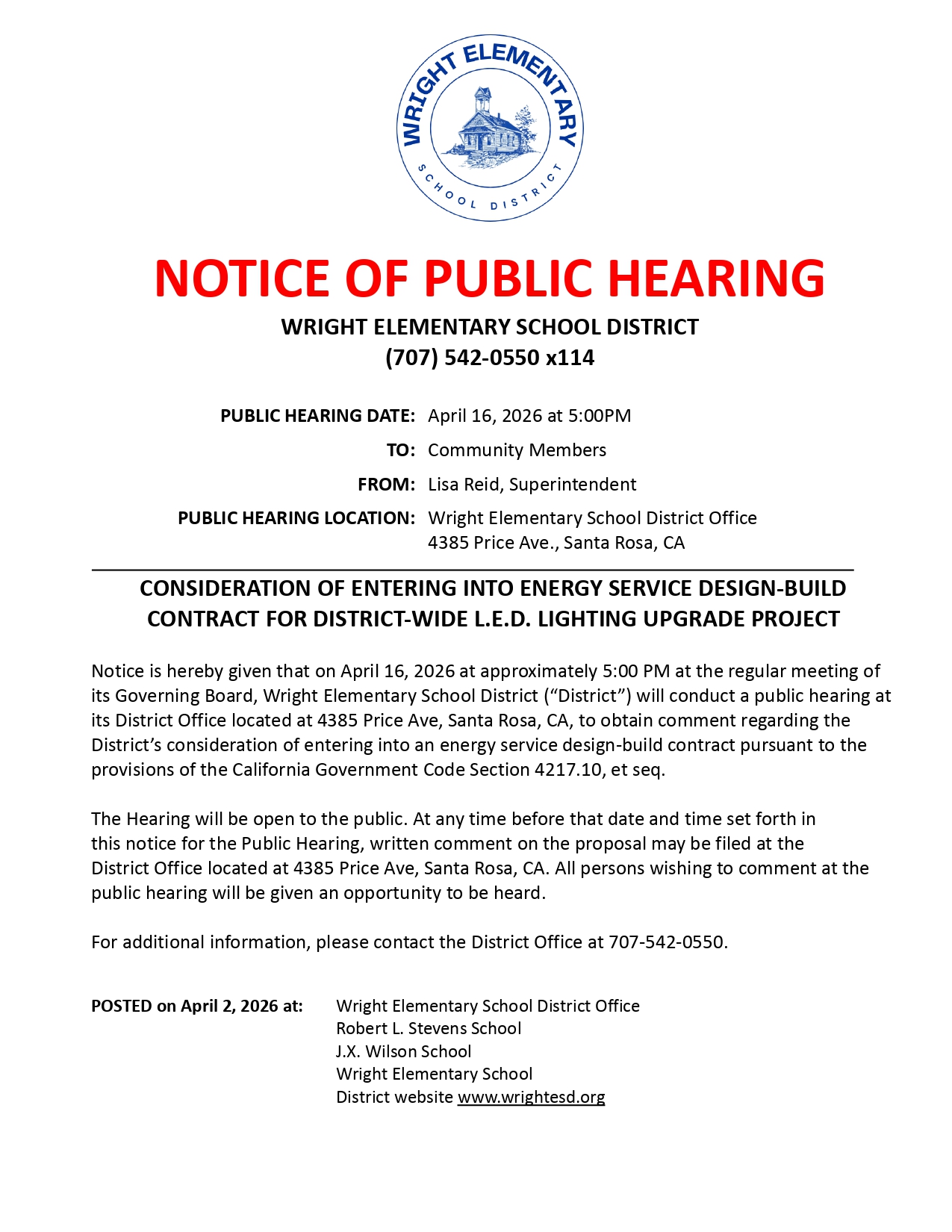
All board meetings are held at the Wright District Office located at 4385 Price Avenue, Santa Rosa, CA 95407. For regular board meetings, Closed Session begins at 4:00pm followed by Open Session at 5:00pm. Times may vary for Special Board Meetings. Please refer to the agenda for details.
Board Meeting Agendas
Public Input Submission
Todas las reuniones de la mesa directiva se llevan a cabo en la oficina del distrito ubicada en 4385 Price Avenue, Santa Rosa, CA 95407. Para las reuniones regulares de la junta, la sesión cerrada comienza a las 4:00pm seguida de la sesión abierta a las 5:00pm. Los horarios pueden variar para las reuniones especiales de la mesa directiva. Por favor refiérase a la agenda para más detalles.

Announcements are sent through ParentSquare
This platform is utilized district-wide to share important information and updates for WESD families from the district, school sites, and teachers.
All parents and guardians (Contact 1 and Contact 2 in Aeries) automatically have an account with ParentSquare. You can either use an invitation that we send you or you can use the "Forgot password?" link on ParentSquare using the email or cell phone number we have on file for you in Aeries to gain access to your account.
If you have any questions, please contact your school office or Liz Lockett at llockett@wrightesd.org.

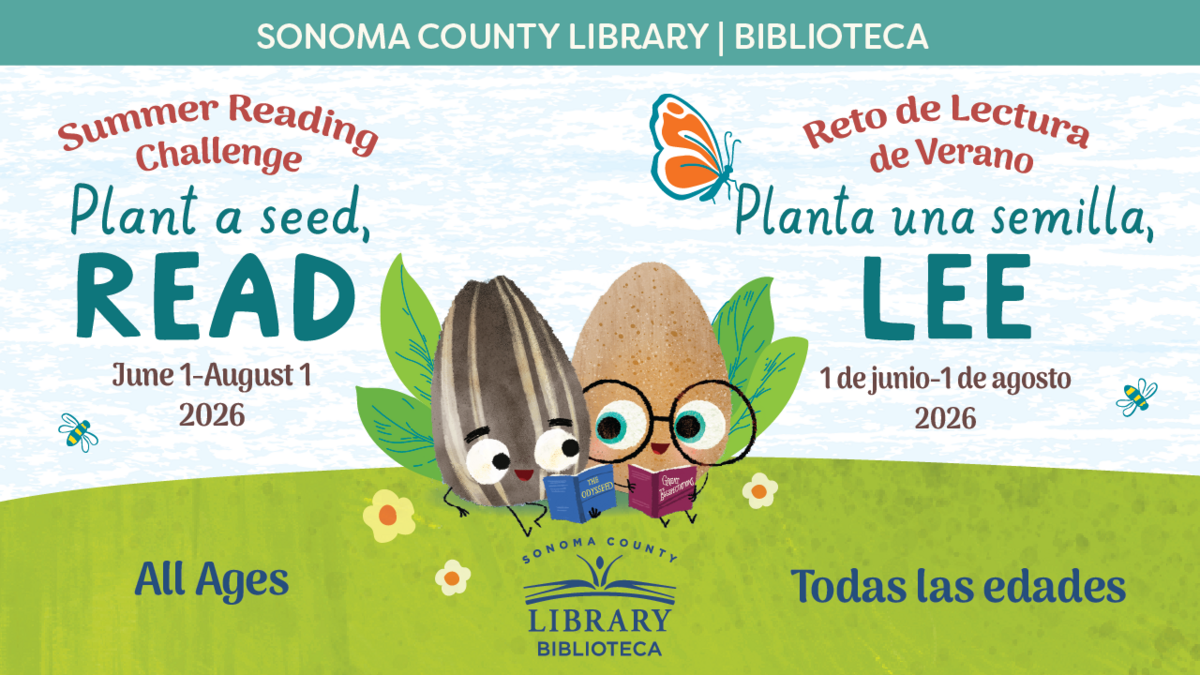
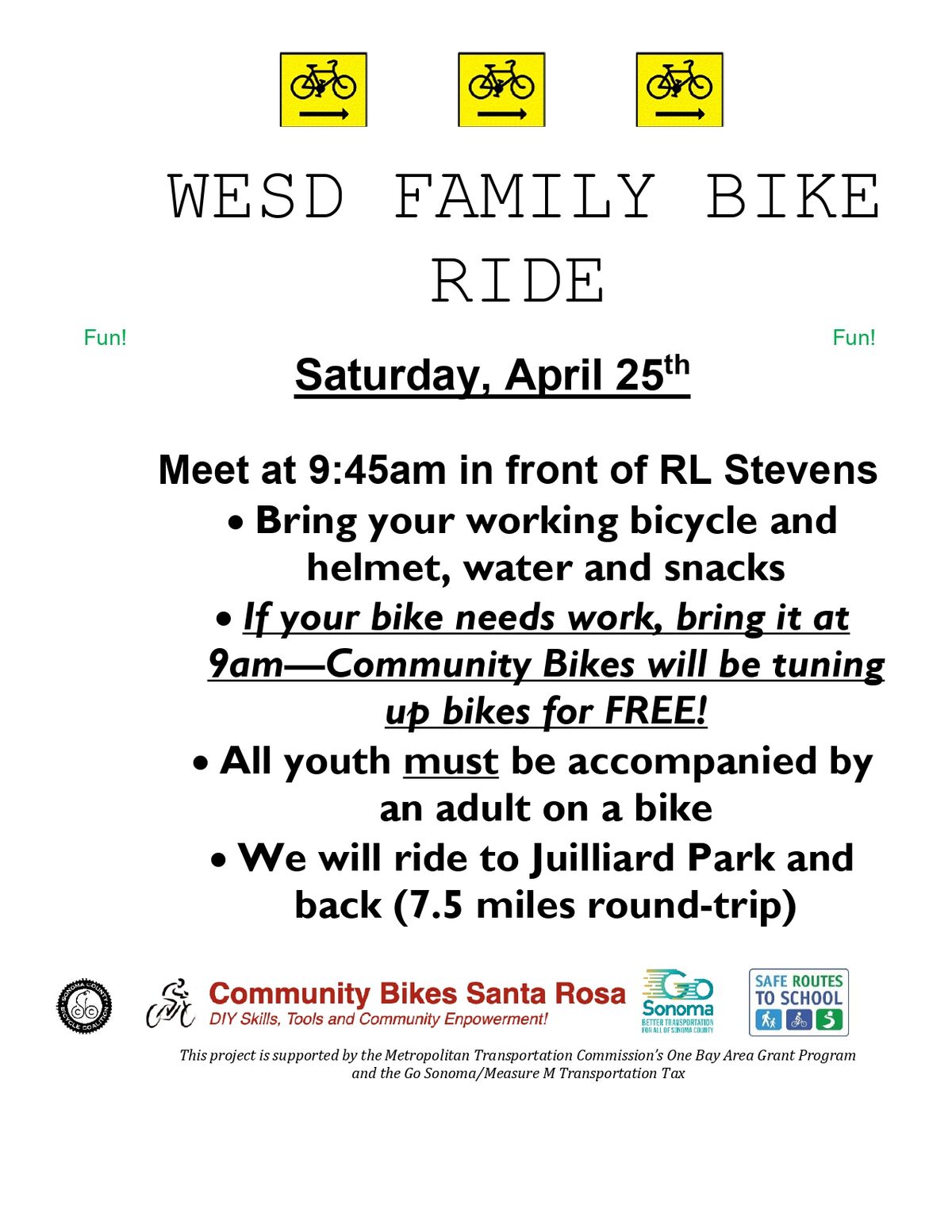
Community Flyers
Flyers will be posted to each school’s website and can be accessed by clicking the Peachjar button on your school’s homepage. Additionally, if you’d like to begin receiving flyers in your email to stay up to date with your child’s school, please register:
- Visit the WESD Peachjar webpage
- Click"My Account" in the top right corner
- Click "Register Now"
- Select account type “Parent/Family Provider”
- Enter requested information; choose your school and/or district you wish to follow
District Information
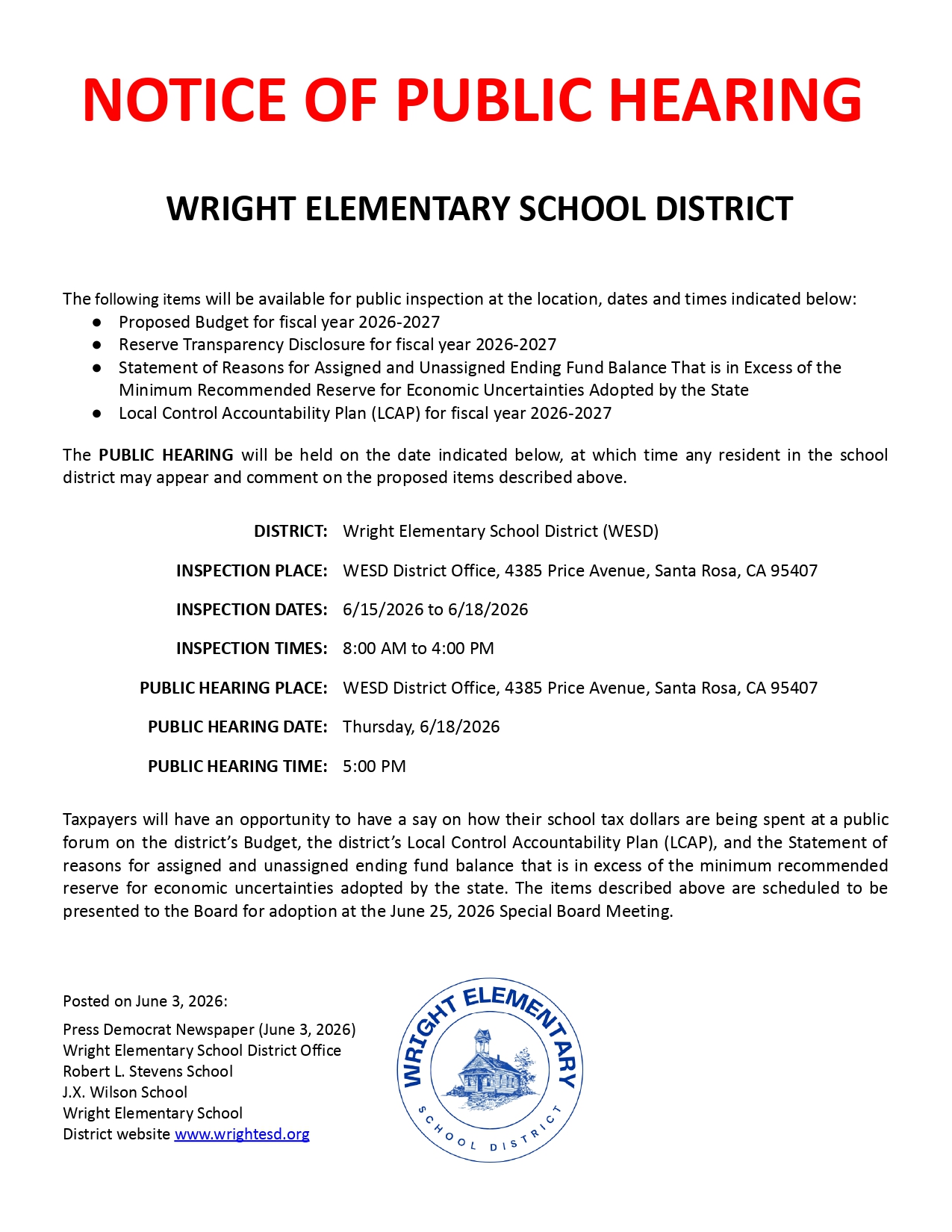
- Public Notices
- Board Meeting agendas will be available at least 72 hours in advance for regular meetings and 24 hours in advance for special meetings.
- Citizens’ Bond Oversight Committee – Join the committee!
- Local Control Accountability Plan (LCAP)
- Bullying, Harassment and Suicide Prevention - Acoso escolar, acoso y prevención del suicidio
- District Calendars
- Know Your Educational Rights - Immigration Status
- Know Your Rights - Uniform Complaint Procedures
- Facilities Use Application and Instructions
About Wright Elementary School District
Wright Elementary School District is a TK-6 public school district, established in 1865 and now educating over 1,100 students per year at on three school campuses. Our schools embrace diversity and achievement, with an emphasis on maintaining safe and respectful communities. We have an outstanding lunch program that serves nutritious meals that are prepared right on campus. Our school staffing includes administrators, teachers, classroom support staff, health services, counseling, school psychologists, speech and language services, clerical support staff, and more. Our recruiting outreach seeks the highest quality teachers, with a preference for bilingual and bi-literate candidates.
J.X. Wilson School is a TK-6 elementary school in the Wright Elementary School District, located in southwest Santa Rosa. The school first opened its doors in the spring of 1976, and this year we serve approximately 518 students in 23 classes. We are proud of our experienced and extremely dedicated teaching staff, our supportive parents, and our recognized level of student achievement. Our teachers hold high expectations for all students, both academically and behaviorally, and our staff works very collaboratively and creatively to provide a rich and rigorous educational program that addresses their diverse range of individual strengths and needs. Schoolwide, we focus on creating a positive, mutually respectful teaching and learning environment, and on cultivating a "caring and considerate community" that engages and supports all of its members.
Opened in 1994, Robert L. Stevens School is a TK-6 elementary school, designed in a process of collaboration with the community it serves. Our staff is a dedicated group of professionals who wanted to be part of creating a unique environment for learning to occur. Both the school’s architecture and its educational focus are built from a strong center. Displays of student writing, artwork, and learning projects welcome the visitor, dignify the learning that takes place, and reflect our mission and vision.
Our original school Wright Elementary School is a charming public elementary school that serves students in grades TK-6. Between 2009 and 2025, the school operated as a charter school serving TK-8, but transitioned back to traditional public school status beginning with the 2025-26 school year. This exceptional school maintains approximately two classes per grade level, creating an intimate learning environment where supportive staff know each student by name and are well-versed in their individual skills and abilities. The campus features clean facilities with a modern multipurpose room, and the school's playing fields serve the broader community, including a large local Little League organization.
Wright District Office is located in southwest Santa Rosa. From Hwy 12, turn left at South Wright Road (Fulton Rd), cross Sebastopol Road, and turn right on Price Avenue. The District Office is on the right, just before Wright Elementary School. Appointments are encouraged to ensure the appropriate staff member is available to assist. You can call (707) 542-0550 to schedule an appointment.
The mission of the Wright Elementary School District is to prepare ALL children academically and socially to function responsibly in society and to envision and achieve their goals in life.